


Throughout my life, whenever faced with a smart, intellectual-looking person with a greater depth in a subject compared to me but with a high dose of cynicism and rudeness, I have always assumed that smartness comes in a package- smart people are often cynics.
Like me, many of us often assume that optimism is naive and that cynicism is realistic. We often confuse cynicism, a distrust of others and a belief that things will inevitably worsen, with genuine realism.
However, when examined through the lens of logic and evidence, this assumption crumbles. Cynicism is not the height of reason, it is often a defensive emotional posture hiding as intellectual rigour. True rationalism, i.e., the commitment to seeing reality as it actually is, requires us to reject cynicism.
The Safety of Negativity
Cynicism is seductive because it is safe. It acts as a psychological armor against disappointment. If you predict that a new policy will fail, that a movement is corrupt, or that people are inherently selfish, you position yourself in a no-lose scenario. If things go wrong, you get to say, “I told you so.” If things go right, you are pleasantly surprised.
But rationalism is not about emotional safety. It is about accuracy and reason.
A rationalist seeks to map their internal model (hypothesis) of the world to external reality (experiment). The cynic, conversely, applies a pre-existing filter where only negative data is allowed to pass. This is the definition of confirmation bias. When a cynic sees a politician do a good deed, they assume it is a PR stunt. When they see global statistics on poverty reduction, they assume the data is manipulated. By deciding the conclusion (that everything is broken) before examining the evidence, the cynic abandons the scientific method.
The Data Against Doom
Is there any scientific evidence of the above claim?
1. The “Cynical Genius” Illusion (Cognitive Science)
The article claims that cynicism is often mistaken for intelligence. Cognitive science strongly supports this claim.
This is evidenced in a landmark study by Stavrova and Ehlebracht (2019) published in Personality and Social Psychology Bulletin investigated the link between cynicism and cognitive ability across 30 countries (approx. 200,000 participants).
They found a consistent negative correlation between cynicism and cognitive competence. While laypeople perceive cynics as smarter, cynics actually performed worse on cognitive tests, literacy, and numeracy.
High cognitive ability allows individuals to process complex social nuances. Cynicism is a “low-resolution” heuristic, a blunt mental shortcut that simplifies the world into “everyone is bad,” essentially saving cognitive energy at the cost of accuracy.
2. The Mathematics of Trust (Game Theory) or How a Computer Tournament Proved Cynicism is Stupid
Trust is a rational survival strategy. Evolutionary mathematics supports this.
In the late 1970s, political scientist Robert Axelrod found himself wrestling with a problem that seemed unsolvable. The Cold War was at its peak. The global mood was paranoid. The prevailing “rational” wisdom of the time was Realpolitik, i.e., assume the worst of your enemy, strike first before they strike you, and never be a sucker.
This is the essence of cynicism. It feels smart because it feels safe.
To test this, Axelrod didn’t turn to philosophy, he turned to code. He organized a tournament based on the Iterated Prisoner’s Dilemma to find the mathematically perfect survival strategy. The results didn’t just change game theory, they debunked the idea that cynicism is “rational” once and for all.
The Setup A Game of Betrayal
Imagine you and an accomplice are arrested. The police separate you. You have two choices: Cooperate (stay silent) or Defect (rat him out).
If you both Cooperate: You both get a short sentence (3 points each).
If you both Defect: You both get a medium sentence (1 point each).
If you Defect but the other person Cooperates: You go free (5 points), and the other person gets the maximum sentence (0 points).
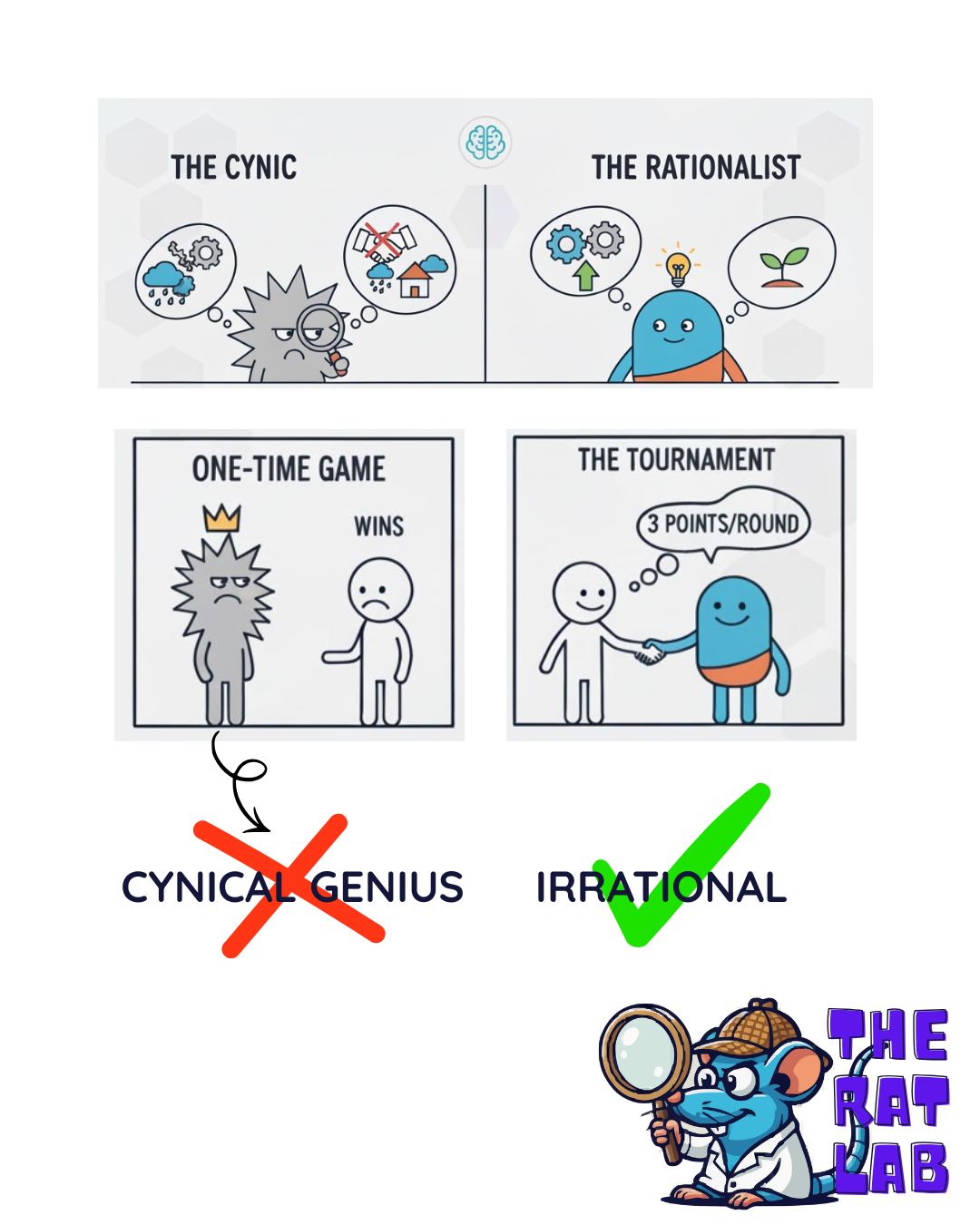
The Cynic looks at this matrix and says: “I must Defect. If the other guy stays silent, I win big (5 points). If he betrays me, at least I protected myself (1 point). Defecting is the only logical choice.”
In a one-time encounter, the Cynic is right. But Axelrod added a twist – iteration. In real life, we don’t just meet people once; we deal with the same colleagues, neighbors, and nations over and over again.
The Battle Royale
Axelrod invited game theorists, economists, and mathematicians to submit computer programs to play this game against each other for 200 rounds.
The entries were diverse.
“Massive Retaliatory” strategies: If you cross me once, I will defect forever.
“Sneaky” strategies: I’ll be nice, but randomly stab you in the back to see if I can get away with it.
“The Cynic” (All-D): Always defect. Trust no one.
The winner, however, was the simplest program submitted. It was written by mathematical psychologist Anatol Rapoport, and it was called Tit-for-Tat. It had only four lines of code and followed two rules:
Be Nice: On the very first move, always Cooperate.
Reciprocate: On every subsequent move, do exactly what your opponent did the last time.
If you hit Tit-for-Tat, it hits you back immediately. If you apologize (start cooperating again), it forgives you immediately.
Why the Cynics Lost
When the dust settled, the “Always Defect” (Cynical) strategies were at the bottom of the leaderboard.
Why? Because cynics kill their own ecosystem.
When a Cynic played against a Cynic, they locked into a death spiral of mutual betrayal, scoring a measly 1 point per round. They survived, but they were miserable.
Tit-for-Tat, however, racked up points by cooperating with the “nice” programs. But critically, it couldn’t be exploited. When a “Mean” program tried to take advantage of it, Tit-for-Tat retaliated instantly, forcing the Mean program to back off or lose points itself.
Axelrod discovered that for a strategy to be evolutionarily successful, it needed to be “Nice” (never defect first) and “Forgiving” (don’t hold a grudge), but also “Provocable” (don’t be a doormat).
The High Cost of Cynicism
This brings us to the “hard science” of why cynicism fails in the real world: Transaction Costs.
In economics, a transaction cost is the expense involved in making a trade. If you live your life as a pure cynic, your transaction costs are astronomical.
Imagine you want to buy a cup of tea.
The Rationalist: Hands over Rs 10, assumes the tea isn’t poisoned, and walks away. Time: 30 seconds.
The Cynic: Assumes the tea shop owner is a thief and the coffee is toxic. They demand to see the whole tea making process, judge the quality of tea, and chemically test the water and milk (exaggerated much?). Time: 45 minutes (I mean longer time).
Because the Cynic refuses to extend “initial trust,” they miss out on Gains from Trade. They are so busy protecting themselves from a potential loss of 5 points that they miss out on a lifetime of accumulating 3-point wins.
The Verdict
Axelrod’s tournament proved that morality isn’t just a fluffy human invention; it is a harsh mathematical necessity.
Cynicism is a short-term hack for a one-time encounter. But in the long game of life, the “smartest” guy in the room isn’t the one sneering in the corner. It’s the one who extends a hand first, but keeps their eyes open. That isn’t naive. That is optimal.
3. Asymmetric Feedback Loops (Behavioral Psychology)
Cynicism leads to confirmation bias. Experimental psychology supports this via “Asymmetric Learning.”
Research by Fetchenhauer and Dunning (2010) explored why cynicism persists if it is inaccurate.
When a rationalist trusts someone and is betrayed, they learn. When they trust and are rewarded, they learn. However, when a cynic distrusts someone, they usually disengage. Because they disengage, they never generate the data that would prove them wrong (i.e., they never find out the person would have been trustworthy).
Cynicism is a self-blinding mechanism. The cynic rarely encounters evidence that contradicts their worldview because their behavior prevents that evidence from being generated.
4. The Physiology of Cynicism (Medical Science) or Yeah, It’s Bad for Your Body!
Cynicism is physically destructive.
A 2014 study in the journal Neurology found that high levels of “cynical distrust” were associated with a three times higher risk of dementia. Cynical hostility is linked to higher baseline levels of cortisol (stress hormone) and pro-inflammatory markers like C-reactive protein and IL-6. From a biological standpoint, cynicism is a state of chronic hyper-vigilance that accelerates cellular aging and cognitive decline.
If we look at the world strictly through data, the cynical worldview is objectively incorrect. By almost every quantifiable metric, child mortality, literacy rates, extreme poverty, violent crime per capita, the human condition has improved drastically over the last two centuries.
A rationalist acknowledges these improvements not to induce a warm fuzzy feeling, but because they are factual. To deny progress because it feels sophisticated to be gloomy is, ironically, an act of delusion.
Conclusion: The Courage to be Clear
Cynicism is intellectually lazy. It answers every question with “it’s all rigged” or “people suck,” effectively shutting down further inquiry.
Rationalism, however, is hard work. It requires the nuance to say, “The world is getting better, but we still have serious problems.” It requires the courage to admit that while corruption exists, so does genuine competence and goodwill.
📚 Recommended Reads
-
Hope for Cynics
The Surprising Science of Human Goodness
🔗 Amazon |
Amazon India
-
The Evolution of Cooperation
🔗 Amazon |
Amazon India