

Recently I boarded a crowded train. The train seat was designed for three people but was occupied by five on a hot, humid summer day. As it was just after noon, people were exhausted. Except for the interactions with the vendors and some loud phone calls, people were generally reluctant to talk. Drinking water – wiping sweat – drinking more water, this was the exact routine while sitting there waiting for the metal tube to move an inch. Suddenly, a middle aged man came and asked the chunk of people, “Do you know if there are TTEs in this train?” . Here, TTE refers to a traveling ticket examiner. At least four people answered. A pair of already exhausted passengers started arguing between themselves about the answer. I suddenly though – why did they answer. I mean – is there a possibility nobody will answer to the question in such a case? I remembered no such instance. Why is this compulsion to reply?
People will answer strangers. They will interrupt their own podcasts to answer. Sometimes, if they are unsure, they will even offer a confident guess, essentially lying, just to avoid leaving the question hanging. There is never a question and then silence (unless of course it is personal or something related to crime).
Why? Why is it that the human brain simply cannot stop itself from responding to a question?
The answer lies at the fascinating intersection of linguistics, cognitive psychology, neuroscience, and evolutionary biology. On the surface it may look like we are being polite. But we are fighting against millions of years of evolutionary wiring and deeply ingrained cognitive architecture that views an unanswered question as an active threat to social cohesion and mental equilibrium.
1. Adjacency Pair
To understand the urge to answer, we first have to look at the structural rules of human language. In the field of conversational analysis (a branch of linguistics and sociology), human communication is governed by strict, albeit unconscious, structural frameworks.
In 1974, sociologists Harvey Sacks, Emanuel Schegloff, and Gail Jefferson published a seminal paper on the organization of turn-taking in conversation. They identified a concept called the “adjacency pair.“ Adjacency pairs are sequences of two utterances that are adjacent, produced by different speakers, and ordered as a first part and a second part. Common examples include greeting-greeting (“Hello” / “Hi”), offer-acceptance (“Want some coffee?” / “Yes, please”), and, most powerfully, a question-answer.
According to Sacks and his colleagues, the “first pair part” (the question) creates what linguists call “conditional relevance.” Once a question is asked, the immediate next slot of time is unconditionally reserved for the answer.
Because of this structural rule, silence in response to a question is never just “nothing.” In linguistics, it is categorized as a “noticeable absence.”
Not answering is not passively doing nothing but actively withholding an answer. Withholding an answer is a highly aggressive conversational move, it signals hostility, defiance, or a breakdown of the social order. Because most humans naturally seek to avoid aggressive social confrontations, the linguistic structure practically forces us into providing the second half of the adjacency pair.
Furthermore, philosopher Paul Grice’s Cooperative Principle (1975) says that participants in a conversation intuitively assume that everyone is trying to cooperate. Grice’s “Maxim of Relation” commands us to be relevant. When a question is deployed, the only relevant action is to resolve it. To ignore it is to violate the fundamental cooperative contract of human language.
2. Open Loops and the Zeigarnik Effect
When we look into the internal workings of the mind, we encounter the cognitive discomfort of the “open loop.”
In 1927, a Russian psychologist named Bluma Zeigarnik was sitting in a bustling Viennese restaurant. She noticed something peculiar. The waiters could remember complex, lengthy orders perfectly right up until the moment the food was delivered and paid for. The moment the transaction was completed, the waiters forgot the orders entirely.
This led to a series of experiments and the establishment of the Zeigarnik Effect – the psychological tendency to remember uncompleted or interrupted tasks better than completed ones. The human mind hates an unfinished task. Uncompleted tasks create a state of cognitive tension like a psychic itch that demands to be scratched.
A question, by its very cognitive nature, is an uncompleted task. It is like a missing piece of a puzzle. When a question is asked, there is an opening of a cognitive loop in the minds of the people around. Our brain automatically processes the language, understands the inquiry, and begins searching its memory banks for the answer.
Once our brain has retrieved the answer, holding onto that information without delivering it causes cognitive dissonance. The loop remains open. Delivering the answer is the only way to close the loop, relieve the cognitive tension, and allow your brain to clear its working memory. We answer questions on a crowded train for the same reason we straighten a crooked picture frame on a wall, our brains crave closure and order.
3. Curiosity and the “Information Gap”
What exactly is happening at the neurological level when a question is asked? To the brain, a question represents an Information Gap.
Behavioral economist and psychologist George Loewenstein proposed the Information Gap Theory of Curiosity in 1994. Loewenstein argued that when we become aware of a gap in our knowledge, it produces a feeling of deprivation. This deprivation is aversive, we don’t like feeling like we are missing something (FOMO – anyone?). But conversely, the act of resolving that gap is highly rewarding.
Neuroscience has backed this up. When the brain encounters a question or a puzzle, it activates the brain’s reward circuitry, specifically the striatum and the midbrain, which are flooded with dopamine. A study by Kang et al. (2009), published in Psychological Science, used fMRI scans to watch people’s brains as they read trivia questions. The researchers found that the brain’s reward networks lit up in anticipation of the answer.
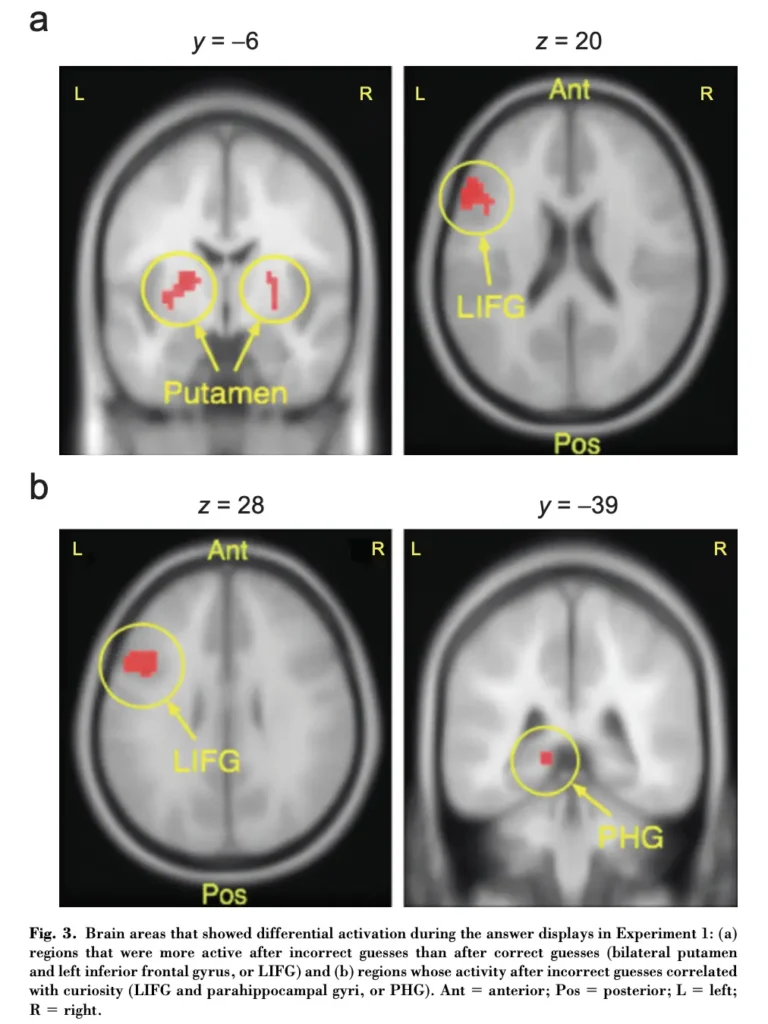
The surprising thing is, our brain’s reward system doesn’t just activate when we are curious – it activates when we resolve uncertainty too. The brain is fundamentally a “prediction machine” (a concept popularized by neuroscientist Karl Friston). It constantly builds models of the world to minimize surprise. When a stranger asks a question, they introduce a micro-state of uncertainty into our environment.
By answering the question, we are resolving the environmental uncertainty. We provide the missing data, restoring order to the shared environment. In return, our brain rewards us with a micro-dose of dopamine. We answer because it biologically feels good to solve a problem.
4. Shared Intentionality and Survival
Why do we care about the uncertainty of a total stranger? If we look at other primates (no surprise here), this behavior is virtually non-existent.
Michael Tomasello, an evolutionary anthropologist and developmental psychologist, has spent his career comparing the cognitive abilities of human children to those of great apes. In his 2008 book, Origins of Human Communication, Tomasello highlights a glaring difference between humans and chimpanzees: the motive to share information helpfully.
If a chimpanzee knows where food is hidden, it will not point it out to another chimpanzee unless there is a direct, immediate benefit to itself. Chimpanzees communicate primarily to request things. Humans, however, communicate simply to inform. Tomasello’s experiments showed that human toddlers as young as 12 months old will point to a dropped object to help a confused adult find it, expecting no reward.
Tomasello attributes this to “Shared Intentionality.” Humans evolved as hyper-cooperative, tribal hunters. Early hominids survived not by being the strongest or fastest, but by collaborating, sharing goals, and sharing information. In an ancestral environment, if a tribe member asked, “Where is the watering hole?” and you silently ignored them, you were jeopardizing the survival of your genetic group.
Answering a question from a stranger taps into this primal evolutionary imperative. It is an act of reciprocal altruism. By answering, you are unconsciously signaling: “I am a cooperative member of the human species. I am a valuable, competent, and pro-social member of the tribe.” The middle aged man on the local train might be a stranger, but our evolutionary hardware still views him as a fellow human, navigating a shared environment.
5. The Automaticity of Language
Another reason we cannot ignore questions is that language processing is largely automatic and involuntary.
Try this experiment: Look at the word APPLE. Try NOT to read it. Try to just look at the shapes of the letters without your brain automatically generating the concept of a red fruit. You can’t do it. This phenomenon, heavily studied in cognitive psychology (most famously through the Stroop Effect), demonstrates that experienced cognitive processes become automatic.
When someone speaks to us in a language we understand, the auditory cortex processes the phonemes, Wernicke’s area extracts the semantic meaning, and Broca’s area begins formulating a response. All these things happen before we have consciously decided whether or not we want to talk to this person.
Psychologist Daniel Wegner’s Ironic Process Theory (1987) further explains why suppressing a response is so difficult. If you try to tell yourself, “Don’t think of a black cat,” your brain has to constantly check in on itself to make sure it isn’t thinking of a black cat which, ironically, keeps the black cat in your working memory. Similarly, if you hear a question and try to force yourself to stay silent, your brain is actively holding the answer in working memory, fighting the urge to vocalize it. It takes significantly more cognitive energy (executive function) to suppress an answer than it does to simply blurt it out.
6. The Urge to Answer Even When We Must Lie
Perhaps the most fascinating aspect of this phenomenon is that people will sometimes answer a question even when they don’t know the truth. You ask a stranger for directions, and rather than admitting they don’t know, they confidently point you the wrong way. They do not necessarily want to harm you – but they will lie. Why do we lie rather than embrace the silence?
There are two behavioral science concepts at play here.
First is the Need for Cognitive Closure (NFC), a psychological concept introduced by Arie Kruglanski in 1989. NFC describes an individual’s desire for a firm answer to a question and an aversion toward ambiguity. Some people have such a high need for cognitive closure that the ambiguity of an unanswered question is agonizing. To resolve the discomfort in the air, they will supply any answer, even a fabricated one, just to close the loop and end the ambiguity.
Second is sociologist Erving Goffman’s concept of “Face-Work” (1955). “Face” is the positive social value a person claims for themselves. In social interactions, we are constantly engaging in “face-saving” behavior. In Western cultures, competence, helpfulness, and intelligence are highly valued traits. When a question is directed at you, admitting ignorance (“I don’t know”) can sometimes be perceived as a minor loss of face. Conversely, providing an answer, even a guessed one, allows the individual to present themselves as knowledgeable and in control. The unconscious desire to maintain a socially competent “face” can occasionally override our commitment to strict factual accuracy.
There is also a colloquial internet adage known as Cunningham’s Law, which states: “The best way to get the right answer on the internet is not to ask a question; it’s to post the wrong answer.” This plays into the same cognitive mechanisms. We are deeply driven to correct misinformation because errors in the shared informational environment are perceived as cognitive irritants. If someone answers the passenger on the train incorrectly, another passenger who does know the truth will almost certainly speak up to correct them, driven by the urge to restore accurate shared intentionality.
Conclusion
The urge to answer is like a cognitive itch.
That urge is a testament to the marvel of human evolution and cognitive design. We are being compelled by linguistic frameworks that abhor a vacuum, cognitive loops demanding closure, dopamine receptors hungry for resolved uncertainty, and millions of years of evolutionary history that bred us to be the ultimate cooperative communicators.
We answer because language connects us in a web that we cannot simply unplug. We answer because our brains are built to solve the puzzles of our shared environment. We answer because, deep down, the human mind recognizes that survival is a group project.
References & Scientific Sources:
- Sacks, H., Schegloff, E. A., & Jefferson, G. (1974). A simplest systematics for the organization of turn-taking for conversation. Language, 50(4), 696-735. (Adjacency pairs and linguistic structure).
- Grice, H. P. (1975). Logic and conversation. In Syntax and semantics (Vol. 3, pp. 41-58). (The Cooperative Principle).
- Zeigarnik, B. (1927). On finished and unfinished tasks. Psychological Research, 9, 1-85. (The Zeigarnik Effect and cognitive open loops).
- Loewenstein, G. (1994). The psychology of curiosity: A review and reinterpretation. Psychological Bulletin, 116(1), 75-98. (Information Gap Theory).
- Kang, M. J., et al. (2009). The wick in the candle of learning: Epistemic curiosity activates reward circuitry and enhances memory. Psychological Science, 20(8), 963-973. (Dopamine and curiosity resolution).
- Tomasello, M. (2008). Origins of human communication. MIT press. (Shared intentionality and evolutionary cooperation).
- Wegner, D. M., et al. (1987). Paradoxical effects of thought suppression. Journal of Personality and Social Psychology, 53(1), 5-13. (Ironic Process Theory).
- Kruglanski, A. W. (1989). Lay epistemics and human knowledge: Cognitive and motivational bases. Springer Science & Business Media. (Need for Cognitive Closure).
- Goffman, E. (1955). On face-work: An analysis of ritual elements in social interaction. Psychiatry, 18(3), 213-231. (Social face-saving behavior).