
Information overload is plaguing the current human collective well being. The human brain, which was optimized through gradual evolution, was optimized for foraging food, shelter and searching for information related to survival. Currently it is suffering an unprecedented mismatch with its environment. By 2026, the digital landscape has transformed from a stream of information into a relentless deluge of algorithmically optimized stimuli and generative AI synthetic content. We are witnessing the death of the “signal.”
[The phrase “death of the signal” refers to a profound shift in how information, culture, and communication are consumed and produced. They are mainly driven by high digital noise and dominance of algorithms. It suggests a transition from a time of shared, high-quality, and intentional content (“signal”) to an era dominated by ephemeral, algorithmically-driven, and often chaotic content (“noise”).]
As an example, a research published in Nature Communications (Accelerating dynamics of collective attention) empirically demonstrated that collective attention is accelerating, with topics rising and falling in popularity faster due to increased information consumption and limited attention capacity. This, combined with high-volume content production, causes faster turnover, shorter attention spans, and more fragmented public discourse.
Longitudinal data across various digital domains (e.g., Google Trends, Twitter, Reddit, Wikipedia, movie sales) shows increasing gradients and shorter periods of peak interest. This means let’s say there is a government scam – people are talking about it. Now, suddenly there is a glittery celebrity news, people are quickly switching to that without resolving the government scam in the first place.
This is not merely a cultural shift. It is a profound neurological burden. The specific brand of decision fatigue 2026 presents is uniquely toxic. A landmark 2022 study (A neuro-metabolic account of why daylong cognitive work alters the control of economic decisions) in Current Biology revealed that prolonged cognitive effort, such as endlessly evaluating if a social media post is true or false and relevance of digital information, leads to a measurable buildup of glutamate in the lateral prefrontal cortex (PFC). This metabolic toxicity literally impairs executive function, forcing the brain to default to low-effort, impulsive, and often irrational decision-making.
To survive this hostile cognitive environment, we cannot rely on willpower. We must adopt a rigorous signal vs noise framework rooted in rationality. Here is how to filter information using three empirically supported mental models for information overload.
Mental Model 1: Sturgeon’s Law (The 90% Rule)
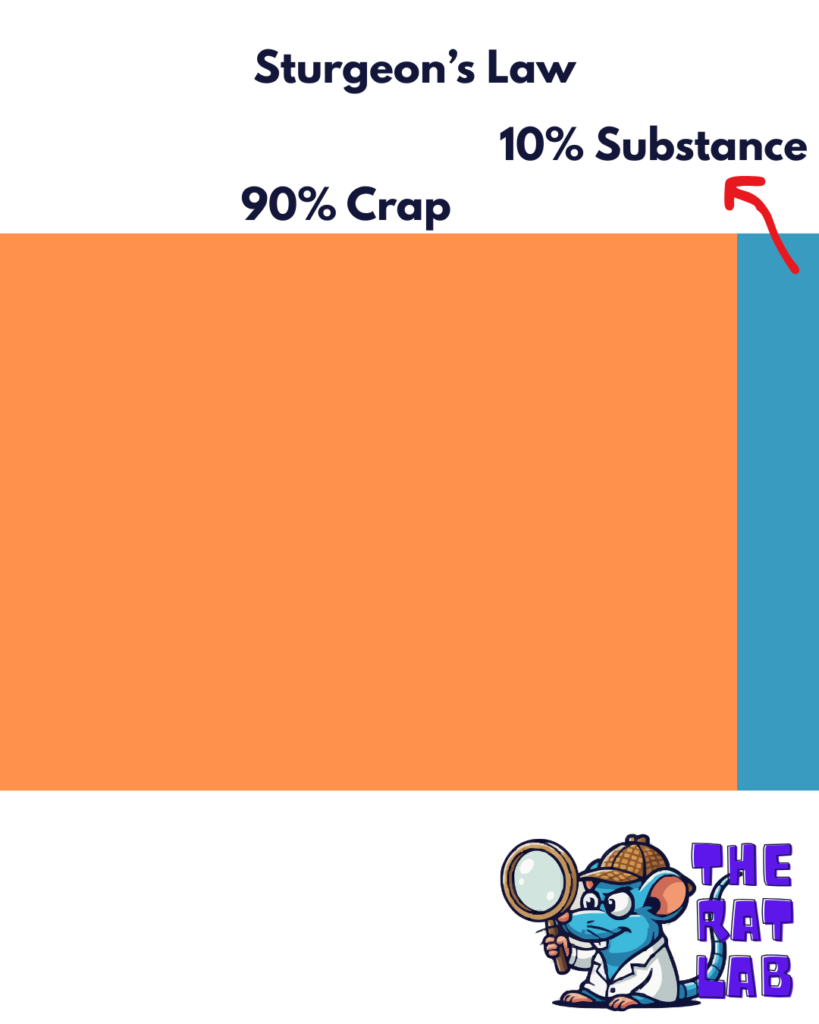
Coined by science fiction author Theodore Sturgeon, the adage states that “90% of everything is crap.” While it originated as a literary defense, Sturgeon’s Law maps perfectly onto established statistical realities of information theory and bibliometrics.
In the science of complex systems, the distribution of quality and impact almost always follows a power-law distribution (or Pareto principle), rather than a normal bell curve. For instance, in peer-reviewed scientific publishing which is arguably the most rigorous information filtering system we possess, citation analyses consistently show that a microscopic fraction of papers generates the vast majority of scientific progress, while the long tail goes entirely unread.
When you apply Sturgeon’s Law as a cognitive heuristic, you immediately drastically reduce your brain’s computational load.
Assume most of the digital information you see (emails, social media, news, AI content) is unimportant noise (90%). This prevents your brain from wasting energy analyzing it. You don’t need to check every piece of information anymore. The data must prove it’s important (in the top 10%) before you spend your limited working memory (which can only hold about four things) on it.
Mental Model 2: The Lindy Effect (Filtering for Timeless Wisdom)
The Lindy Effect says that the future life expectancy of non-perishable entities, like technologies, ideas, or books, is directly proportional to their current age. If a philosophical concept or a foundational text has survived for 500 years, it is statistically likely to survive another 500. Crucially, this does not necessarily mean that this concept is true or false – it is going to survive- that’s all.
From an evolutionary biology and cultural transmission perspective, the Lindy Effect is a manifestation of survival analysis. Let’s say somebody wrote a book which establishes Earth is Round. Now if somebody comes up with a book proposing the Earth is Flat, they have to disprove a ton of theories, explain numerous practical phenomena and support all future theories.
In a media ecosystem optimized for “breaking news,” our amygdala (a brain center which works as primary processor for emotions, particularly fear, anxiety, and aggression) is constantly hijacked by the perception of urgency. However, every new information can’t reliably predict the future; its accuracy hasn’t been tested over time. Applying the Lindy Effect is the ultimate strategy for how to filter information. By deliberately prioritizing older, heavily vetted information (e.g., reading a classic textbook on behavioral economics rather than a trending thread on social media about market fluctuations), you basically use time as a distributed, peer-reviewed filter. This maximizes your signal-to-noise ratio while minimizing the cognitive expenditure of fact-checking ephemeral data.
Mental Model 3: The Circle of Competence or Understand What You Actually Understand vs What You Think You Understand
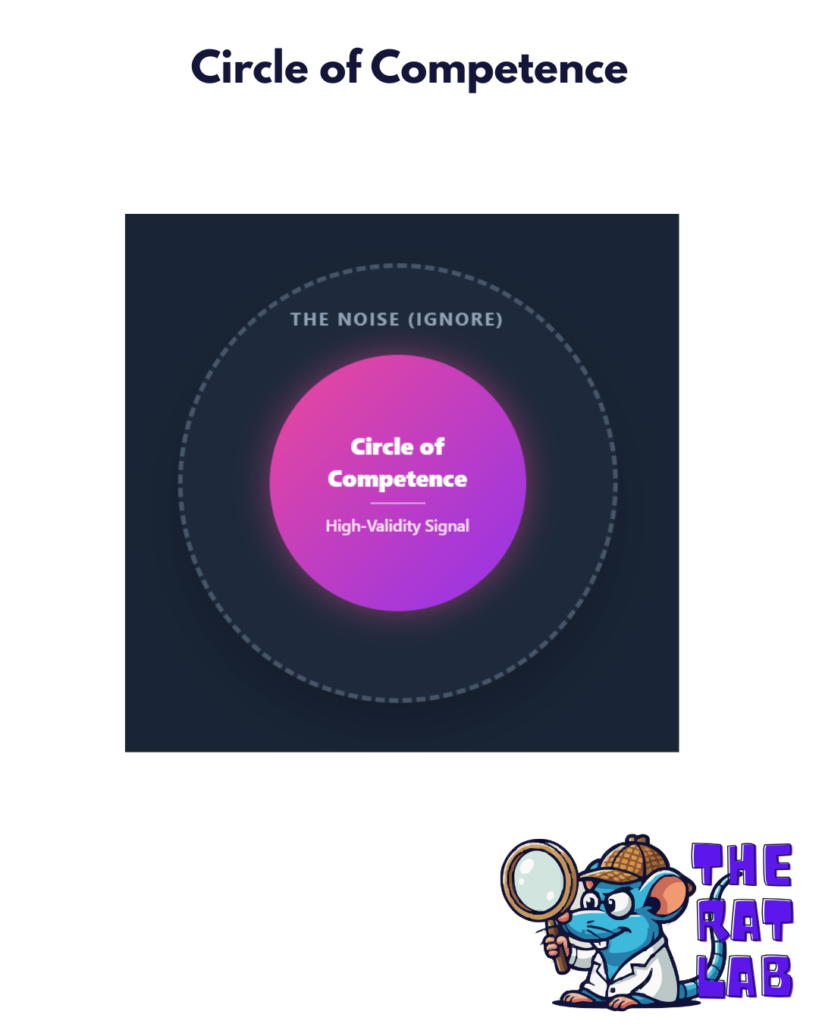
Popularized by investors like Warren Buffett, the Circle of Competence dictates that you should define the boundary of what you truly understand and ruthlessly ignore everything outside of it.
The scientific validation for this model is rooted in the concept of “bounded rationality,” pioneered by Nobel Laureate Herbert Simon. The human mind has finite processing capabilities and operates under strict constraints of time and available information. Studies by psychologists Daniel Kahneman and Gary Klein (American Psychologist, 2009) show that experts can only make reliable, fast decisions when they’ve practiced for a long time in consistent, predictable situations (“high-validity environments”).
When you step outside your Circle of Competence, say, a software engineer doom-scrolling through complex epidemiological data or geopolitical military strategy, you lack the requisite mental schemas to process the information. Your brain is forced into metabolically taxing “System 2” or fast thinking, attempting to parse noise without the foundational knowledge to identify the signal. Defining and enforcing your Circle of Competence or basically understanding what you understand is a form of neuro-protection.
It prevents the dilution of your actual expertise, where you have put a lot of effort and years of practice. This also guards against the illusion of explanatory depth, a cognitive bias where we falsely believe we understand complex systems simply because we have consumed surface-level information about them. ‘I know about this because I listened to a podcast yesterday.’
How to do a “Low-Noise” Digital Diet
Understanding these models is insufficient. They must be operationalized to protect your prefrontal cortex. Here is a scientifically grounded approach to curating your digital diet in 2026:
- Enforce Asynchronous Consumption (The Lindy Delay): Stop consuming news in real-time. The brain’s default mode network (DMN), responsible for memory consolidation and deep integration of knowledge, is actively suppressed by constant external stimuli. Implement a “Lindy delay.” Wait 48 hours to a week before reading about a major event (preferably from a newspaper of choice). If it still matters a week later, it has crossed the threshold from noise to signal.
- Aggressive Pruning via Sturgeon’s Law: Knowing 90% of the information is crap, audit your inputs ruthlessly. Unsubscribe from newsletters, mute social media accounts, and block algorithmic feeds. Assume 90% of your current digital inputs are causing glutamate buildup in your prefrontal cortex without offering actionable intelligence. If a source does not consistently prove it is in the 10% of high-density signal, eliminate it.
- Establish Epistemic Boundaries: Write down your actual areas of expertise and immediate operational needs (your Circle of Competence). When confronted with inflammatory or complex information outside this circle, practice epistemic humility. Say, “I do not have the schemas to process this efficiently,” and scroll past. You are not remaining ignorant. You are strategically deploying your finite metabolic resources. You can not possibly learn and do lots of things. Choose a main expertise and some hobbies.
In an era where attention is the most aggressively mined resource on the planet, mastering these mental models is not just a productivity hack. It is a biological imperative to protect human cognition.
Read other articles here.
Read about Rationality 101.