

Introduction
Let’s face it, when most people hear the words “scientific thinking,” they picture a serious scientist in a white coat, surrounded by test tubes and formulas or staring into the void of a microscope.
Cold. Clinical. Detached. But reality is different, scientific thinking doesn’t have to be heartless or robotic. In fact, especially in today’s diverse world, with its masala of traditions, emotions, and beliefs, true scientific thinking has to come with a generous side of empathy.
What Is Scientific Thinking Anyway?
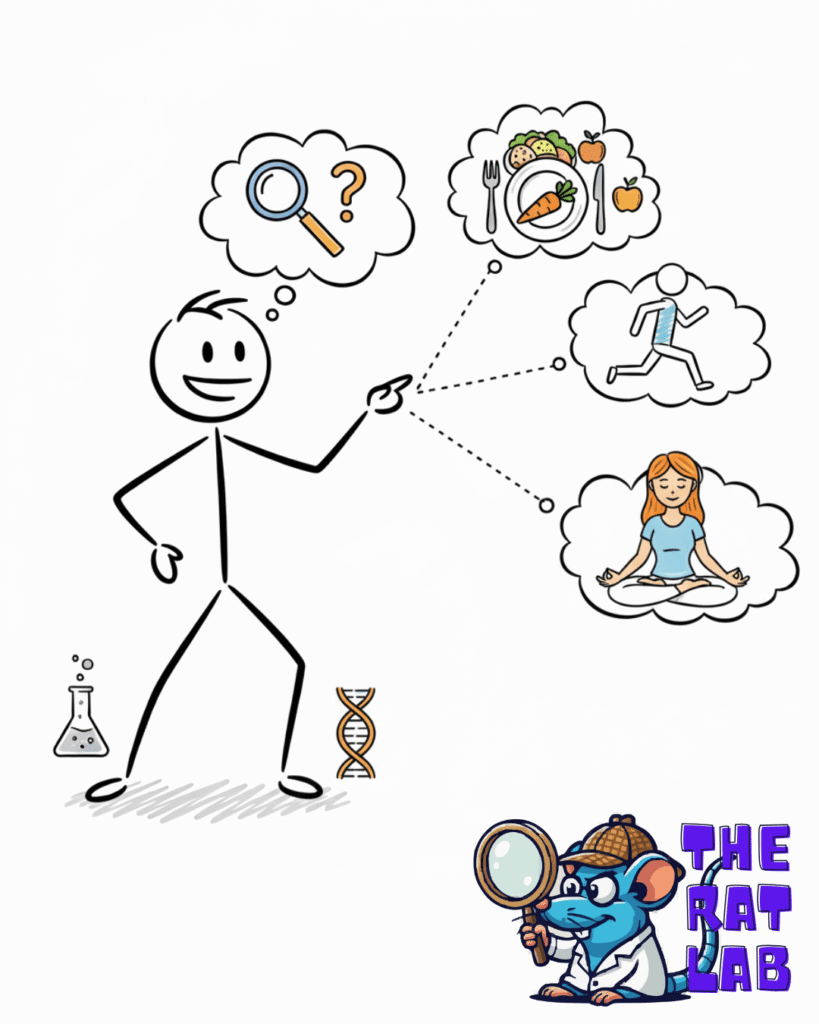
We could have quoted a scientist or a complicated study to explain scientific thinking but it is not that complicated. At its core, scientific thinking is just a fancy way of saying, “Ask good questions, and don’t stop until you’ve found honest answers.” It’s not limited to labs and rocket launches. It’s something we all do when we wonder, “Why is my phone battery dying so fast?” or “Does that turmeric milk actually help me sleep?”
The process is a loop.
Method
Science Meets Culture: Testing Without Trashing
In many countries around the world such as India, Mexico, Nigeria, knowledge doesn’t just come from textbooks. It flows through grandmothers’ advice, temple rituals, village remedies, and yes, WhatsApp forwards. Here’s the cool part: scientific thinking doesn’t say “throw it all out.” It says, “Test it first.” So, if grandma’s herb mix cures your sore throat, science asks: what’s in it that works? Maybe tulsi (holy basil) has antimicrobial properties. Maybe lemon boosts your immunity. But if something doesn’t work or worse, causes harm, science gives us the courage to say, “Let’s find a better alternative,” without disrespecting the tradition behind it. This is how tradition is changed in a better direction.
It’s not about choosing between culture and science. It’s about blending respect with reason. Discarding everything wrong in a culture using scientific thinking.
The Sun, The Earth, and a Change of Perspective
Let’s travel back in time. For over 1,500 years, everyone (and their astrologers) believed Earth was the center of the universe. That’s what the geocentric model said and religious leaders loved it. Then came Copernicus, who said, “Nah, it’s the Sun.” Then came Galileo, who used a telescope to prove it and promptly got into major trouble for speaking against convention.But his scientific thinking eventually changed how we see the entire universe. Another example can be drawn from the field of medicine. In the 1800s, cholera was wreaking havoc across India. Many believed it came from angry gods or bad air. Enter Dr. Sambhu Nath De. In the 1950s, working in Kolkata, he proved that the cholera bacteria makes a powerful toxin that messes with your body’s fluid balance. His discovery led to Oral Rehydration Therapy (ORT), a cheap, simple solution that has since saved millions of lives.
That’s what happens when curiosity meets compassion: rational thinking with real-world impact.
The Invisible Chains: Biases That Warp Our Thinking
Here’s the catch. Scientific thinking sounds great in theory, but in practice, it’s carried out by… well, humans. And humans have biases sneaky little mental shortcuts that mess with our objectivity.
Anchoring Bias
Let’s say you wake up with a sore throat. First, Google result says “strep throat.” Boom, you’re convinced. Now, no matter what other symptoms pop up (runny nose, body ache), you’ll twist them to fit that first idea. In science, this happens all the time. An early theory becomes “the anchor,” and researchers unknowingly design studies to fit that theory even when better explanations are right under their noses.
Confirmation Bias
This one’s a classic. You believe people with glasses are more intelligent. Now, every time a bespectacled person says something smart, it confirms your theory. But when they say something dumb? You ignore it, or chalk it up as a fluke. In research, this leads to scientists unintentionally focusing on data that supports their favorite theory and brushing off anything that doesn’t.
Like a football referee, calling only what supports their team.This can creep into social science too. A researcher strongly in favor of a government policy may highlight success stories, while downplaying evidence of where it failed without even realizing they’re doing it.
So, what’s the Takeaway?
Scientific thinking isn’t just about facts and formulas. It’s about:
- Staying curious (never stop asking “why?”),
- Being honest with the evidence (even if it stings),
- Testing ideas before blindly trusting them,
- And most importantly, bringing empathy to the process—especially in a country as diverse and deeply cultural as India.
Further Reading
While there is not a particular book which encompasses the whole of scientific thinking. But the following sources inspires scientific thinking for sure.
📚 Recommended Reads
-
Demon Haunted World:
Science as a Candle in the Dark —
🔗 Amazon |
Amazon India
-
Dreams of a Final Theory —
(selected parts)
🔗 Amazon |
Amazon India




[…] [Rationality 101] [Scientific Thinking 101] […]
[…] [Scientific Thinking 101] [Rationality 101] […]
[…] [Scientific Thinking 101] [Rationality 101] […]