

[This article is heavily inspired by a similar article by the entrepreneur Steven Blank]
Tons of words have been written about “Viksit Bharat 2047,” the “Startup India” revolution, and India’s aspiration to be a $5 trillion economy. Indians celebrate unicorns and laud UPI success stories. But few people ask what, exactly, fuels the next generation of hard technology? Who are the people in the labs at 2 AM? What do they actually do? And more importantly, why should a fintech founder in Bengaluru or a policy-maker in Delhi care?
(Unfortunately, you won’t see answers to these questions in the mainstream media. Images of unpaid scholars protesting don’t make for good PR. Nor will you hear a succinct description from the universities themselves. They are too busy fighting bureaucratic fires to explain their value to the general public.)
In this post, we are going to describe how the Indian science ecosystem works, how it is supposed to feed into our “Atmanirbhar” (self-reliant) ambitions and why the current state of neglect is switching off the engine of our future.
How Science Works
Like Steven, I too was older than I care to admit when I finally understood the difference between a scientist at IISc, an engineer at ISRO, an entrepreneur, and a VC; and the role each plays in making our economy thrive and our borders secure.
Scientists
Scientists (often called Research Scholars or JRFs/SRFs in India) are the people asking “why” and “how.” They may know the answers (in that case they are verifying or re-searching) or they don’t know the answers yet. They are driven by curiosity and should be fueled by stipend, if it arrives on time or even if it arrives (India Research Watch poll flags stipend crisis – 25% of PhD scholars earn less than Rs 10,000 pm ~ 112 USD per month). They are known by the names of PhD students, PosDocs, Research Assistants, Researcher etc. They make hypotheses and run experiments. Most of the time, they are making small progress or are outright wrong. But when they are right, they move science (and nation) forward. We get indigenous vaccines, new crop varieties to survive our changing monsoons, and materials that make our defense tech lighter and stronger.
Scientists in India generally fall into two categories:
Theorists: Theorists develop mathematical models and abstract frameworks. They don’t run the machines. They use chalkboards (or iPads) to predict phenomena. You’ll find them at places like TIFR (Tata Institute of Fundamental Research), IISc (Indian Institute of Science), the Indian Statistical Institutes and IITs. Theorists in Physics may research String theory, Black hole thermodynamics, quantum systems, properties of novel materials etc. Theorists in Mathematics may research Number theory, Cryptography (the basis of our digital security) and (countable but) numerous specialized mathematical domains. On the other hand, theorists in Computer Science may be designing algorithms that eventually optimize our logistics or AI models.
Experimentalists: Experimentalists design and run experiments to test these theories. These are the people in white coats you see in stock photos, but in reality, they are often covered in grease or chemical stains in labs at CSIR (Council of Scientific and Industrial Research) labs, IITs, or IISERs. They build the prototypes for what might eventually become a product.
A point to note: Some experimentalists are pretty good in theory and some theorists have vivid ideas about how to design an experiment. In fact, most of the time their works follow an inter-twined framework of hypothesis, experiment and results.
Both theorists and experimentalists can work on two types of scientific realms, basic science and applied science.
Basic Science: Trying to understand the properties of a new 2D material. ———->> Applied Science: Using that material to build a better battery for an electric scooter.
Basic Science: Mapping the specific electrical signals neurons in the motor cortex use to trigger muscle movement. ———->> Applied Science: Developing a Brain-Computer Interface (BCI) that decodes those signals to allow a paralyzed person to control a robotic arm with their thoughts.
Basic Science: Studying how bacteria in salt marshes use a specific gene editing system (CRISPR) to defend themselves against viruses. ———->> Applied Science: Repurposing that system to create a gene-editing tool capable of curing genetic diseases like Sickle Cell Anemia in humans.
Where is Science in India Done?
India’s insight post-independence was to build a dual structure: government labs for strategic missions (DRDO, ISRO, DAE) and universities for teaching and research.
The Public Research Behemoths: Unlike the US where corporate R&D is massive, in India, deep science is almost entirely government-funded.
- CSIR Labs: A network of 37 labs (NCL, NPL, CDRI) intended to do industrial research.
- Strategic Labs: DRDO (Defense), ISRO (Space), DAE (Atomic Energy). These are mission-mode agencies which focus on defence.
Research Universities & Institutes This is where the fresh blood enters the system.
- Tier 1 (The INIs): IITs, IISc, IISERs. These are our “R1” equivalents. They have world-class equipment (often funded by DST-FIST) and attract the top JEE/GATE rankers.
- State & Central Universities: The vast majority of Indian science happens here. They are often under-resourced but are critical for democratizing access to science.
The Ecosystem: How It’s Supposed to Work
The government (via the Department of Science and Technology (DST), Department of Biotechnology (DBT), and the new Anusandhan National Research Foundation (ANRF) provides grants.
- Money flows to Principal Investigators (Professors) at IITs/Universities.
- Talent (PhD Scholars) uses this money to run experiments and write papers.
- Breakthroughs occur (e.g., a new molecule, a patentable process).
- Translation: Deep Tech startups or Industry partners license this tech (via incubation cells like SINE at IIT Bombay or C-CAMP).
- Economy: New products are made in India, new defense technology is transferred to the army or navy or air force, reducing imports and creating high-value jobs.
Times and again it has been seen that successful science research paves a path towards successful startups.
Example 1: Material Science & Biotech
Startup: Axio Biosolutions (Based in Bengaluru – incubated at Nirma University with DST fund)
Basic Science: Studying the chemical properties of Chitosan, a biopolymer extracted from shellfish shells. Researchers investigated how its positive charge interacts with negatively charged blood cells to trigger clotting mechanisms.
Applied Science: Developing Axiostat, a sterile haemostatic dressing that stops profuse bleeding from gunshot wounds or accidents in less than 3 minutes. It is now a standard part of the Indian Army’s survival kit and exported to 40+ countries.
Example 2: Marine Biology & Energy
Startup: Sea6 Energy (Incubated at IIT Madras)
Basic Science: Researching the growth cycles of tropical red seaweed and identifying specific enzymes capable of breaking down the tough carbohydrate structures found in marine plants.
Applied Science: Creating the SeaCombine, an automated ocean farming tractor that cultivates seaweed at scale, and converting that biomass into biostimulants for agriculture and eventually renewable biofuels to replace crude oil.
Example 3: Physics & Computational Electromagnetics
Startup: Simyog (Spin-off from IISc Bengaluru)
Basic Science: Solving complex Maxwell’s equations (fundamental laws of electricity and magnetism) to predict how electromagnetic waves behave and interfere with each other inside dense electronic circuits.
Applied Science: Building Compliance-Scope, a simulation software that allows car manufacturers (like Mercedes or GM) to “test” their electronics for interference virtually, avoiding expensive physical crash-testing and hardware prototyping failures.
The Engine We Are Switching Off
Here is the terrifying part. We are currently starving the very first step of this chain.
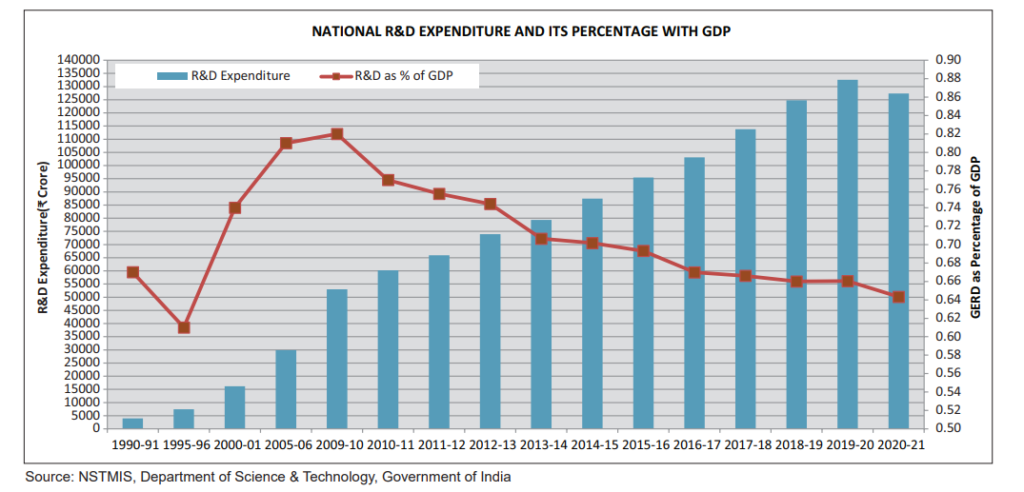
1. The Funding Winter is Here While we talk of “Viksit Bharat,” India’s Gross Expenditure on R&D (GERD) has stagnated at ~0.64% of GDP, one of the lowest among major economies (compared to ~2.4% in China or ~3.5% in the US).
2. The “Stipend” Crisis The “unseen engine” of Indian science is the PhD scholar. For the last few years (and acutely in 2024-25), thousands of scholars across the country have gone months (sometimes 8 to 12 months) without receiving their fellowships due to bureaucratic glitches, “zero-balance account” mandates, and the chaotic rollout of new schemes like Vigyan Dhara. Imagine asking a startup founder to build a unicorn while withholding their salary for a year. That is what we are doing to our scientists. They are leaving labs to take IT jobs just to pay rent. We are hemorrhaging our brain trust.
3. The ANRF Paradox The new Anusandhan National Research Foundation (ANRF) was announced with a massive ₹50,000 crore budget. It promised to be a game-changer. But the fine print matters: ~70% of that funding is expected to come from the “private sector.” Indian industry has historically invested very little in basic R&D, preferring to import technology or focus on services. Expecting them to suddenly fund 36,000 crores of basic science is a dangerous gamble. If the private money doesn’t show up, and the government money remains flat, the engine stalls.
4. The “Atmanirbhar” Trap There is a growing pressure to fund only “translational” or “applied” research—science that solves an immediate problem. “Why are you studying the mating habits of fruit flies? Build me a drone!” But as history shows, you cannot have Applied Science without Basic Science.
- No Quantum Mechanics (Basic) = No Semiconductors (Applied).
- No mRNA research (Basic) = No COVID Vaccines (Applied).
- No General Relativity (Basic) = No GPS (Applied).
We can think in another way – No Differential Geometry (a branch of Mathematics) = No General Relativity, No Linear Algebra = No Computer Science and No Quantum Mechanics, the list goes on.
By forcing our scientists to become short-term product developers and code writers, we are eating our seed corn. We might get a few gadgets and food delivery apps today, but we are killing the discoveries that would have powered the industries of 2050.
5. The Pseudoscience Leakage: Current Indian government is not promoting scientific thinking in anyways. While “hard science” researchers struggled for grants, the government actively created and funded programs for research that lacked scientific merit.
- SUTRA-PIC (Cow Science): In 2020, multiple scientific ministries (DST, DBT, DSIR) were directed to launch the SUTRA-PIC program (Scientific Utilisation Through Research Augmentation-Prime Products from Indigenous Cows).
- The Claim: The call for proposals sought research on the “uniqueness” of indigenous cows, including using cow dung for toothpaste and cow urine for cancer and diabetes, and claimed Indian cows have “special” physiological qualities not found in foreign breeds.
- The Deviation: Over 400 Indian scientists wrote an open letter demanding the withdrawal of this funding call, noting it was “agenda-driven” and aimed at “confirmation bias” (proving a religious belief) rather than open inquiry. The government prioritized this despite the lack of any preliminary evidence suggesting cow urine cures cancer.
- The “Panchagavya” Clinical Trials: The Ministry of Ayush, in collaboration with other bodies, initiated clinical trials to validate Panchagavya (a mixture of cow dung, urine, milk, curd, and ghee) as a medicine.
- Proof: This diverted medical research resources towards testing a concoction based on ritual purity rather than biochemical plausibility, at a time when funding for tuberculosis and malnutrition research remains critical.
- Ayush Budget vs. Modern Science:
- The budget for the Ministry of Ayush (which includes Homeopathy—a globally recognized pseudoscience) saw a massive hike, rising to ₹3,712 crore in 2024-25.
- Context: While investing in traditional herbal medicine (Ayurveda) has valid pharmacological potential, a significant portion of this budget promotes Homeopathy (which is merely sugar pills/placebo) and unverifiable “Vedic” theories. This money is effectively removed from the pool available for evidence-based biotechnology or medical research.
The government has also used its platforms to legitimize pseudoscience, damaging the scientific temperament.
- Indian Science Congress (ISC) Decline: The ISC, traditionally opened by the Prime Minister, has become a platform for outlandish claims.
- Examples: At recent congresses, speakers (often backed by political patronage) have claimed that stem cell technology existed in the Mahabharata (Kauravas were test-tube babies) and that ancient Indians had interplanetary aircraft (Vimanas) that could fly backwards.
- Government Complicity: Instead of distancing itself, the government has often defended these claims as “Indian Knowledge Systems,” conflating mythology with history and science.
Why You Should Care
If you are a founder, an investor, or a citizen, this matters to you.
- Deep Tech needs Deep Science: You cannot build an AI, SpaceTech, or BioTech ecosystem on top of a crumbling scientific foundation. You will eventually run out of IP and be forced to license it from China or the US.
- National Security: In a world where technology is a weapon (semiconductors, drones, bio-warfare), relying on imported science is a security risk.
- The Talent Pipeline: If the smartest students see that pursuing a PhD means poverty and begging for stipends, they will leave. They will go to the US or Germany, and they will build their economies, not ours.
The Bottom Line
India has the talent. India has demand for scientific innovations. India has institutions. But we are currently treating Science as a luxury item rather than a utility. You can switch off the lights in the lab to save money on the electricity bill, but don’t be surprised when you wake up in the dark.