

If I tell you that I know at least three of your core personality traits, would you belive? Let’s see:
1) You have a great deal of unused capacity which you have not turned to your advantage.
2) While you have some personality weaknesses, you are generally able to compensate for them.
3) You are someone who values family and friends.
Was I right? There is a good chance I was, at least partially.
Let’s assume you are an intelligent person – thoughtful, curious, perhaps even skeptical – but when someone says something that sounds insightful, you end up believing it, despite the fact that the opposite might be true.
For instance, a highly educated corporate professional might believe a numerologist’s generic warning that “a subtle betrayal by a close associate will test your boundaries next month,” interpreting it as a unique, personal prophecy rather than a statement applicable to almost anyone in a competitive environment. When a vague and generalized statement like this makes someone feel that it was personalized for them – the effect is termed as Barnum effect.
What exactly is the Barnum/Forer effect?
The Barnum Effect, also known as the Forer Effect, is a cognitive bias where individuals believe that vague, highly generalized personality descriptions are uniquely tailored to them and describe their personality accurately, even though the statements are general enough to apply to almost anyone. The term “Barnum Effect” was coined by psychologist Paul Meehl, referring to the showman P. T. Barnum’s purported saying, “There’s a sucker born every minute,” highlighting how easily people can be deceived by generalized flattery. The alias “Forer Effect” honors psychologist Bertram R. Forer, who first demonstrated the phenomenon experimentally in 1948 by giving his students an identical, generic personality profile which they overwhelmingly rated as highly accurate and personal
How the Barnum/Forer Effect Works
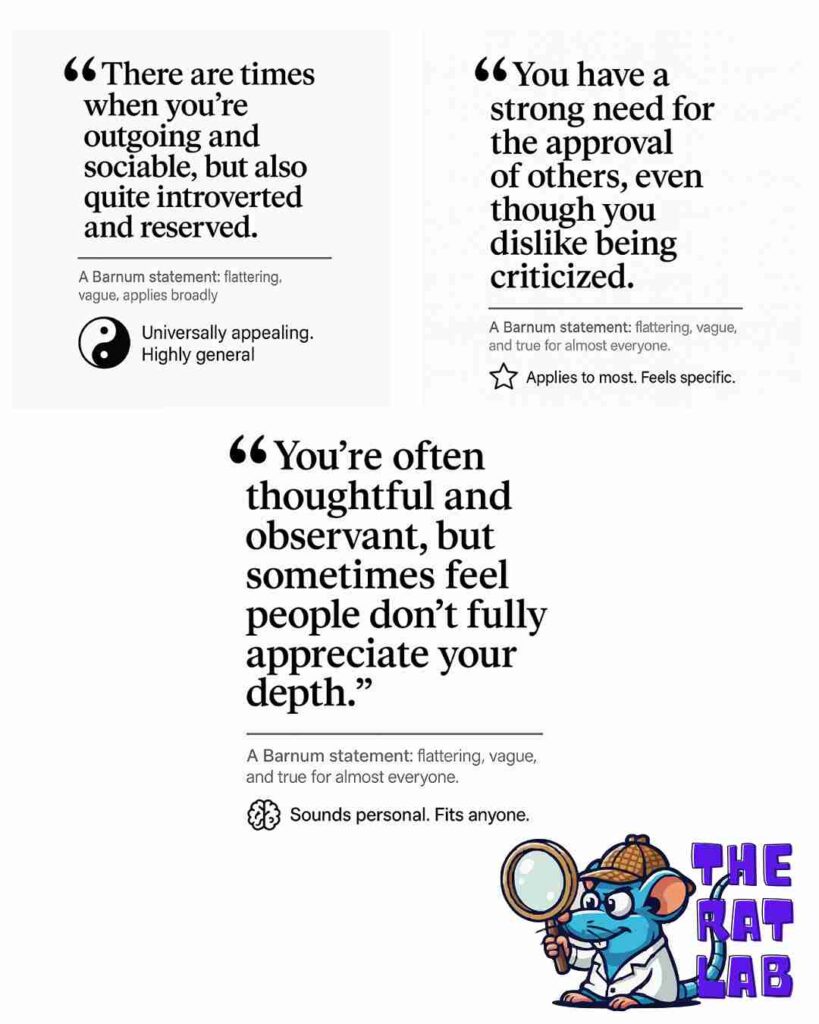
Vagueness and Universal Applicability: The statements, often called Barnum statements, are deliberately vague and contain universal human experiences or traits (e.g., “At times you are extroverted, affable, sociable, while at other times you are introverted, wary, reserved”). This vagueness allows the recipient to easily find personal meaning and selectively recall instances where the statement was true for them, making it feel customized.
Positive Tilt and Wishful Thinking: The descriptions are typically weighted toward positive or flattering traits (or flaws accompanied by a redeeming quality), such as “You have a great deal of unused capacity which you have not turned to your advantage.” People are more likely to accept agreeable or complimentary information about themselves due to a strong desire for a positive self-image and personal validation.
Perceived Authority: The acceptance of the description is significantly enhanced when the feedback comes from a source perceived as having high authority or expertise (e.g., a psychologist, a well-known astrologer, a tarot card reader). The belief in the source’s credibility lowers the recipient’s skepticism, leading them to assume the generic information must be specific to them.
Why it thrives today (and in India)
Mainstream Indian media has become a fertile ground for Barnum-style content flattering, vague, and universally relatable “personality” insights dressed up as psychology. Lifestyle sections of outlets like The Times of India routinely publish one-minute optical illusion “tests” that promise to reveal whether readers are logical, observant, creative, or emotional. A TOI article, for instance, told readers that a single glance could determine if they were “logical or observant” labels so general and complimentary that nearly anyone could agree. Similarly, The Indian Express has amplified TikTok and Pinterest trends, such as Mia Yilin’s viral “introvert/extrovert” illusions, prompting thousands of comments like “omg so me,” textbook examples of the Forer or Barnum effect in action.
This appetite for personalized yet generic “insight” extends beyond entertainment into commerce. Algorithms further amplify this ecosystem. Social media feeds favor content that triggers self-recognition (“this is so me!”), and headlines promising to reveal one’s “deepest insecurity” from a single glance receive millions of shares. When major outlets label these pieces “psychology-backed,” engagement soars, creating social proof loops that legitimize one-size-fits-all interpretations.
Underlying it all is India’s deep cultural comfort with guidance and authority. From spiritual gurus to life coaches, advice especially when framed warmly and non-specifically travels easily. In this environment, phrases like “you’re caring yet firm” or “under-recognized but rising” feel personal, even when written for everyone. Together, these forces media, market, workplace, algorithms, and culture explain why Barnum effects thrive so powerfully in contemporary India.
Where you meet it beyond horoscopes
Beyond astrology, the Barnum effect quietly powers much of modern culture especially in marketing, self-help, social media, workplace feedback, and wellness advice.
Advertising copywriters routinely use flattering yet vague slogans like “You deserve the best” or “Be the real you” to create the illusion of personal relevance and emotional connection with a brand.
The same mechanism drives the success of self-help books and motivational talks that promise “personal transformation” through universal affirmations such as “You have untapped potential”—phrases that feel uniquely insightful but apply to almost everyone.
On social media, the effect amplifies further: personality quizzes, memes, or “Which character are you?” reels deliver generic but flattering templates that millions interpret as self-revelatory truths. Even in workplaces, managers may use broad statements like “You show leadership potential but sometimes hesitate under pressure”—feedback that sounds individualized yet fits most employees. Wellness influencers exploit a similar dynamic with vague health cues—“You often feel tired but try to stay positive”—which invite people to project their own experiences onto general advice.
In all these cases, the illusion of specificity combined with a positive emotional tone activates the same psychological bias that once made horoscopes feel personal .
📚 Recommended Reads
-
Why People Believe Weird Things
Pseudoscience, Superstition, and Other Confusions of Our Time
🔗 Amazon |
Amazon India
-
Flim-Flam!
Psychics, Esp, Unicorns, and Other Delusions
🔗 Amazon |
Amazon India
-
Demon Haunted World:
Science as a Candle in the Dark —
🔗 Amazon |
Amazon India
The psychology that makes it sticky
Self-Enhancement and Positivity Bias
People readily accept feedback that protects their self-esteem. Barnum statements are typically flattering, leading individuals to rate them as more accurate than neutral or negative feedback, filtering out inconsistencies. This bias makes even non-diagnostic, ego-flattering language feel diagnostic.
Need for Meaning and Self-Insight
People crave coherent narratives about their identity. Vague but balanced descriptions (e.g., “analytical and emotional”) offer a simple, satisfying framework. Individuals project their own experiences and memories onto broad descriptors, turning ambiguity into personalized meaning.
Illusion of Authority and Personalization
The effect intensifies when the source appears scientific, spiritual, or expert (e.g., “AI-generated profiles,” “psychology-backed quizzes”). The authority heuristic dictates that people grant higher truth value to information presented with institutional or expert cues, making generic statements feel bespoke.
Confirmation Bias and Selective Recall
People overweight confirming evidence and downplay contradictions. Vague statements like “outgoing at times but reserved when needed” can fit any behavior. Readers remember the “hits” and forget the “misses,” reinforcing their belief in the description’s accuracy.
Ambiguity Tolerance and Interpretive Flexibility
Barnum statements are semantically open and hedged (using words like “sometimes” or “often”). This invites personal elaboration, a mechanism called the personal validation fallacy, where the reader’s own thoughts provide the missing specificity.
Emotional Reward and Cognitive Ease
Accepting positive, smoothly phrased feedback feels good, triggering reward circuits. This cognitive ease—the brain’s tendency to process simple, fluent statements easily—is often misinterpreted as truth, making the vague praise “stick” through emotional comfort.
How to self-defend (a reader checklist)
🔍 Specificity and Falsifiability
A genuine insight should pass the Specificity Test: if the statement—like “You value honesty”—could apply to virtually everyone you know, it lacks diagnostic value. The Falsifiability Test asks if the statement is truly insightful or merely safe. Barnum statements are often “right either way” (e.g., “You can be outgoing, but also reserved”). A statement that risks being wrong, yet turns out right, is far more convincing.
🧪 Source and Valence
The Source Test questions the basis of the information. Credible personality measures rely on validated data, not vibe-based quizzes, arbitrary algorithms, or astrology, which provide the illusion of authority. The Valence Test notes that flattery is a key component: the feedback is typically warm praise (“You are kind…”) often tempered by a weak hedge (“…but sometimes misunderstood”) to appear balanced and credible without risking self-esteem.
🔄 A/B Test (The Core Trick)
The A/B Test directly reproduces Forer’s original experiment. By swapping your profile with a friend, you realize the powerful personal validation fallacy. If you both feel “seen” by the identical text, the power lies not in the text’s accuracy but in your mind’s ability to selectively recall and interpret its vague language to fit your self-image.
[Gen Z is obsessed with astrology. How to get out of it if you want to?, Rationality 101]